
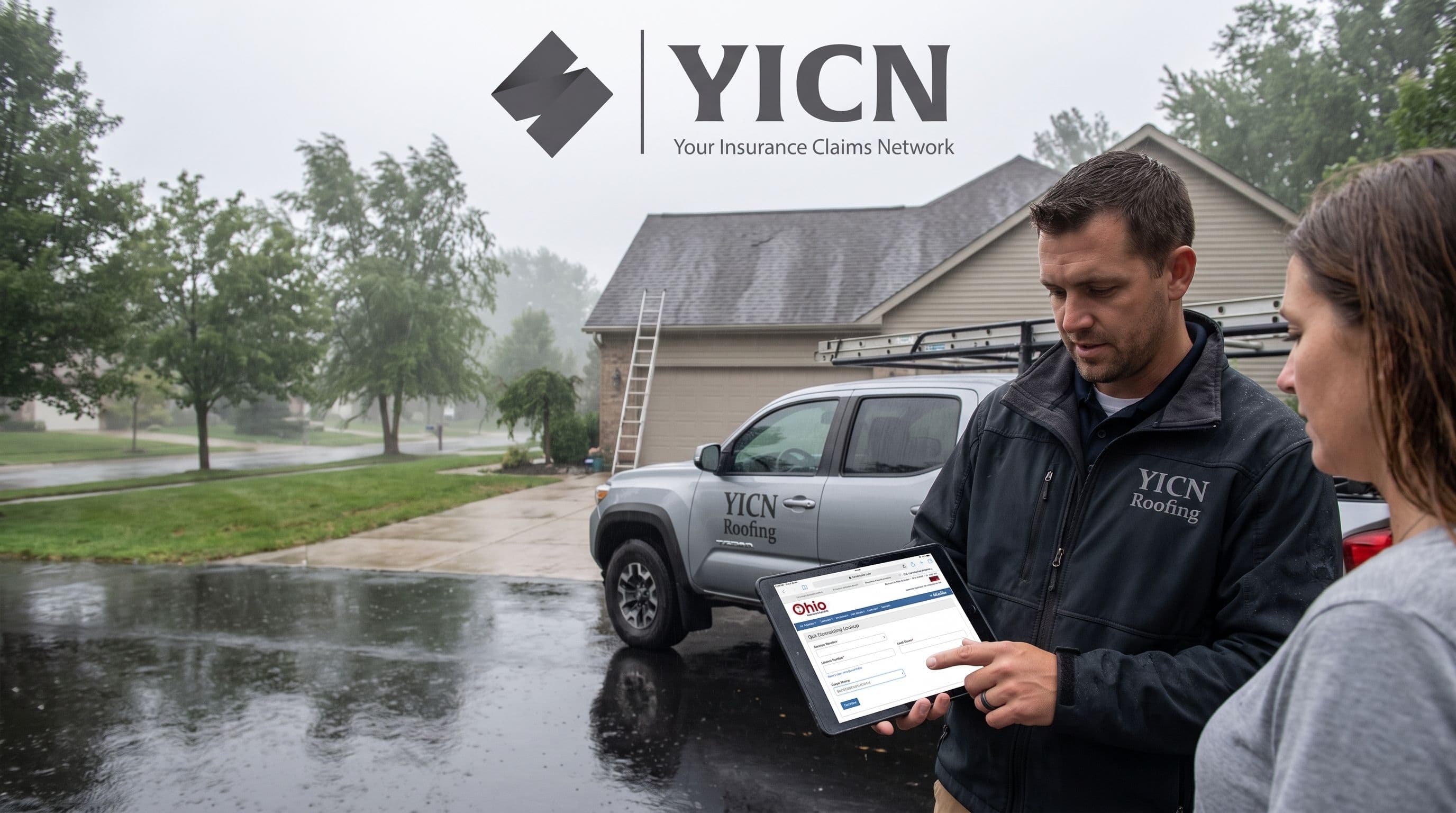
Hear a quick audio overview of Insured Roofing Company: Why It Matters & How to Verify (2026).
Every roofing company says "licensed and insured." Most homeowners take it on faith. This guide closes that gap. Here's what those two words actually mean, which certificates to demand, and how to verify them in one phone call. Plus what happens in Ohio when an uninsured roofer falls on your property.
Key Takeaways
- Demand two certificates: general liability (property damage) and workers' compensation (crew injuries)
- Have them sent directly from the insurer or agent — never accept a photocopy from the contractor
- In 2024, falls killed 389 construction workers — more than 35 percent of all construction deaths (BLS/OSHA)
- In Ohio, workers' comp is a no-fault state system; if the contractor has no coverage, an injured worker can come after you
- Most homeowner policies cap medical payments at just 1,000 to 5,000 dollars — nowhere near a serious fall claim
The Two Certificates That Protect Your Home
"Insured" is two different policies. They cover different disasters. You need proof of both.
General liability insurance
This covers damage to *your property* and other people's. The ladder gouges your siding. A dropped bundle of shingles cracks the driveway. A nail in a tire, a torn tarp, a dumpster sunk into the lawn — all liability claims.
The standard for roofing contractors is 1,000,000 dollars per occurrence and 2,000,000 dollars aggregate. Owens Corning requires its Preferred Contractors to carry at least 1,000,000 dollars in general liability. That's the bar for a manufacturer-backed warranty network — a good bar for you too.
Workers' compensation insurance
This covers the *crew*. A roofer slips on a wet deck. A ladder shifts on uneven ground. A nail gun misfires. Roofing is dangerous work — OSHA reports that falls are the leading cause of death in construction, with 389 fatal falls to a lower level out of 1,034 construction fatalities in 2024. More than 35 percent of construction deaths start with a fall.
If the crew isn't covered and someone is hurt on your roof, the medical bills don't just disappear. They look for a deep pocket. If you own the home, that pocket might be yours.
What Happens When an Uninsured Roofer Falls on Your Property
Ohio runs workers' compensation as a no-fault state system. Injured workers file claims through the Ohio Bureau of Workers' Compensation. They don't have to prove anyone was negligent. When the employer carries coverage, the system takes care of the injured worker. You're out of it.
When the employer has no coverage, the picture changes. An injured worker can sue the property owner for medical bills, lost wages, and damages. Your homeowner policy has a medical-payments provision. But it's small. Most policies cap it at just 1,000 to 5,000 dollars. A serious roofing fall costs far more. And the resulting claims can drag on for years.
Here's the uncomfortable math. A new roof runs $8,000 to $18,000, and permits add 50 to 200 dollars depending on your city. The uninsured bid that comes in a few hundred dollars lower isn't cheaper. It's you, self-insuring a worst-case fall.
How to Request Proof the Right Way
Don't ask "are you insured?" — every company says yes. Ask for paper, and make the paper come from the right place.
Ask for a certificate of insurance (COI). This is a standard one-page document — the insurance industry calls it an ACORD 25 form. It shows the carrier, the policy numbers, the coverage types, and the limits.
Have it sent directly from the insurance agent. Any agent or insurer can email a certificate in minutes, at no cost. A certificate the contractor hands you could be doctored, expired, or canceled.
Make sure your name and address are on it. You want to be listed as the certificate holder. It should be dated within days of your request.
Call the insurer to verify. The certificate lists a phone number for the carrier. A five-minute call confirms the policy is active. Do this for both certificates.
Check the dates against your project timeline. Coverage should be current for the entire job. A certificate that expires mid-project is a gap you don't want to explain to a claims adjuster later.
A legitimate roofing company does this every week. It costs nothing. It takes minutes. Resistance to any of these five steps is the clearest red flag in hiring. Our red-flags guide covers the rest.
The Ohio Specifics
Two Ohio facts change how you verify a roofer's insurance:
Ohio workers' comp comes from one place. Ohio is a monopolistic state-fund state. Private employers buy workers' comp through the Ohio BWC, not from a private carrier. So the workers' comp proof you want is the contractor's Ohio BWC policy and certificate of coverage — bwc.ohio.gov explains the system, and the contractor can produce their BWC certificate on request.
Ohio has no statewide roofing license. Ohio doesn't issue a state contractor's license for roofing the way it does for plumbing or electrical work. That makes the insurance question *more* important here, not less. Local registration and manufacturer certifications carry the weight instead. Here's our full guide to verifying a roofing company in Ohio — registration rules, lookups, and what "licensed" honestly means here.
How to Read a Certificate of Insurance
The ACORD 25 form is dense, but you only need five fields.
Field | What it shows | What you want to see |
|---|---|---|
Insured | The company you're hiring | The exact legal name on the contract |
Certificate holder | Who the certificate was issued to | Your name and address |
Policy numbers | The active policies | Match the two coverages you asked for |
Effective / expiration dates | Coverage window | Covers your whole project start to finish |
Limits | Dollars per occurrence | 1,000,000 per occurrence / 2,000,000 aggregate |
One line matters more than the rest: the "Description of Operations" box. A good certificate names roofing work at your address there. That keeps the coverage tied to your job, not just to the company in general.
The Subcontractor Trap
Here's a gap that catches careful homeowners. The company you hire shows you valid certificates. Then a different crew shows up on install day. The named subcontractor has no coverage of their own.
It happens more than you'd think. A company with coverage can still hand your job to an uninsured sub. The paper you verified covers the company you interviewed — not the people on your roof.
Close the gap with two questions. First: will your own employees do the work, or will you use subcontractors? Second: do all subcontractors carry their own workers' comp and liability, with certificates to prove it?
A company that runs W-2 crews has one payroll, one BWC account, and clean coverage. A company that assembles 1099 crews job by job may carry real gaps — and storm chasers running out-of-town labor are the worst version of this pattern. Ask before install day, not after.
The Five-Minute Verification Call
Calling the insurer sounds formal. It's easier than ordering takeout. The certificate lists the carrier's phone number. Call it and say this:
"I have a certificate of insurance for [company name] in front of me. I'm hiring them for roofing work at my home. Can you confirm the policy is active, and that the limits match what's printed here?"
That's it. The agent confirms three things. The policy is active. The limits are real. The coverage applies to the work you described. Write down the date, the name of who you spoke with, and what they confirmed. If anything is off — the policy lapsed, a payment is pending, the limits are lower — you just learned it for free.
No legitimate insurance agent minds this call. They make it daily. What you should never hear: "we can't verify policies" from a carrier printed on a valid certificate.
Why Insured Quotes Cost a Bit More
Real insurance costs real money. A company carrying 1,000,000 dollars of liability plus full workers' comp prices that protection into every bid. The low-bid competitor without coverage isn't passing savings to you. They're converting your homeowner policy into their insurance plan.
Certifications are a useful proxy here. Manufacturers verify insurance before they certify anyone. GAF requires proof of licensing and insurance before granting Master Elite status. Fewer than 2 percent of roofing contractors in North America hold it. A certified, insured, local company isn't the expensive option. It's the one that still exists when something goes wrong. For the full decision process, see how to choose a roofing company in Northeast Ohio.
Serving Bedford, Bedford Heights, and All of Northeast Ohio
We're Bedford Heights-based and serve the whole region. When you call us, the certificates come from our agent. General liability, plus workers' comp through Ohio BWC. Before you sign anything. See what local homeowners say about our Bedford Heights roofing work, then read how our free roof inspection works. Free inspection and itemized estimate: (937) 756-2124 or reach us here.
Related Guides
Frequently Asked Questions
About the Author: Kevin Stone , chairman and founder of YICN Roofing (Your Insurance Claims Network), Northeast Ohio's premier storm damage roofing contractor serving homeowners throughout Bedford Heights and the surrounding 30-mile radius. Operating from the company's headquarters at 5420 Mardale Ave, Bedford Heights, OH 44146, Kevin has transformed YICN Roofing into a top-rated roofing company with an A+ Better Business Bureau score and over 100 satisfied customers who trust his expertise for their most critical roofing needs. Since establishing YICN Roofing, Kevin has built a reputation that extends far beyond traditional roofing services. His comprehensive understanding of the insurance claims process, combined with decades of hands-on roofing expertise, has positioned YICN Roofing as the go-to contractor for Northeast Ohio homeowners facing storm damage, emergency repairs, and comprehensive roof restoration projects. Available 24 hours a day at (937) 756-2124, Kevin ensures that no homeowner in Bedford Heights, Cleveland, Akron, or surrounding communities is left vulnerable to the elements when roofing emergencies strike. Northeast Ohio Roofing Expertise and Regional Understanding Kevin's deep expertise in Northeast Ohio roofing stems from his intimate understanding of the region's unique weather challenges and architectural requirements. The Greater Cleveland area, including Bedford Heights and surrounding communities, faces some of the most demanding weather conditions in the Midwest. Lake-effect snow systems regularly dump heavy loads on residential roofing systems, while spring and summer storms bring devastating wind and hail damage that can compromise even the most well-maintained roofs. Throughout his career, Kevin has personally overseen thousands of roofing projects across Northeast Ohio, from emergency tarping services during severe storms to complete roof replacements for homes damaged by hail, wind, and ice. His experience spans residential neighborhoods in Bedford Heights, where older homes require specialized attention to maintain their architectural integrity, to newer developments in surrounding communities that benefit from modern roofing materials and installation techniques.