
Hear a quick audio overview of How to Document Roof Storm Damage for Your Insurance Claim (2026).
A roof insurance claim is decided by paperwork before it's decided by policy language. The adjuster never saw the storm; the claim file IS the storm as far as the insurer is concerned. And the difference between a claim that sails through and one that turns into a supplement fight is almost always the same thing. Did someone document the damage the right way, in the first 72 hours, before anything got patched? This is the process — the same one we use when we document claims for Northeast Ohio homeowners, and the reason the claims we support move to approval at rates around 85 percent.
Key Takeaways
- Document before you repair: the claim file is built from date-stamped photos taken before any patching, tarping, or cleanup
- The first 72 hours matter most — mitigation receipts (tarping typically 200 to 1,000 dollars) are part of the claim; damage a tarp would have prevented may not be
- The photo set is a pattern: wide, mid-range, close, interior — every damaged elevation, from the ground
- Keep damaged items and receipts until the adjuster has seen them
- Never guess the cause; state the date and source of the storm (NWS Cleveland logs every event) and let the inspection determine what it did
The Documentation Kit
Before the first photo: a phone with date/location stamps on, a notebook, and a folder (paper or digital) for receipts. That's the whole kit. The goal is a claim package an adjuster can read without calling you twice.
Step 1: Wide Shots — Every Elevation, From the Ground
Start far enough back that each side of the house fills the frame. One photo per elevation minimum, plus corners where two elevations meet. These establish two things adjusters need. First, which sides were exposed to the storm direction. Second, the condition of the whole property — not just the roof. A typical four-side home produces 4 to 8 wide shots before the detail work even starts.
Step 2: Mid-Range — The Roofline Details
Zoom to the eaves, gutters, vents, chimneys, and siding. Soft metals show hail first: gutter dents, downspout bruises, damaged vent caps. Mid-range shots prove the damage pattern on the accessories. That pattern supports what the close-ups show on the shingles.
Step 3: Close-Ups — The Evidence Layer
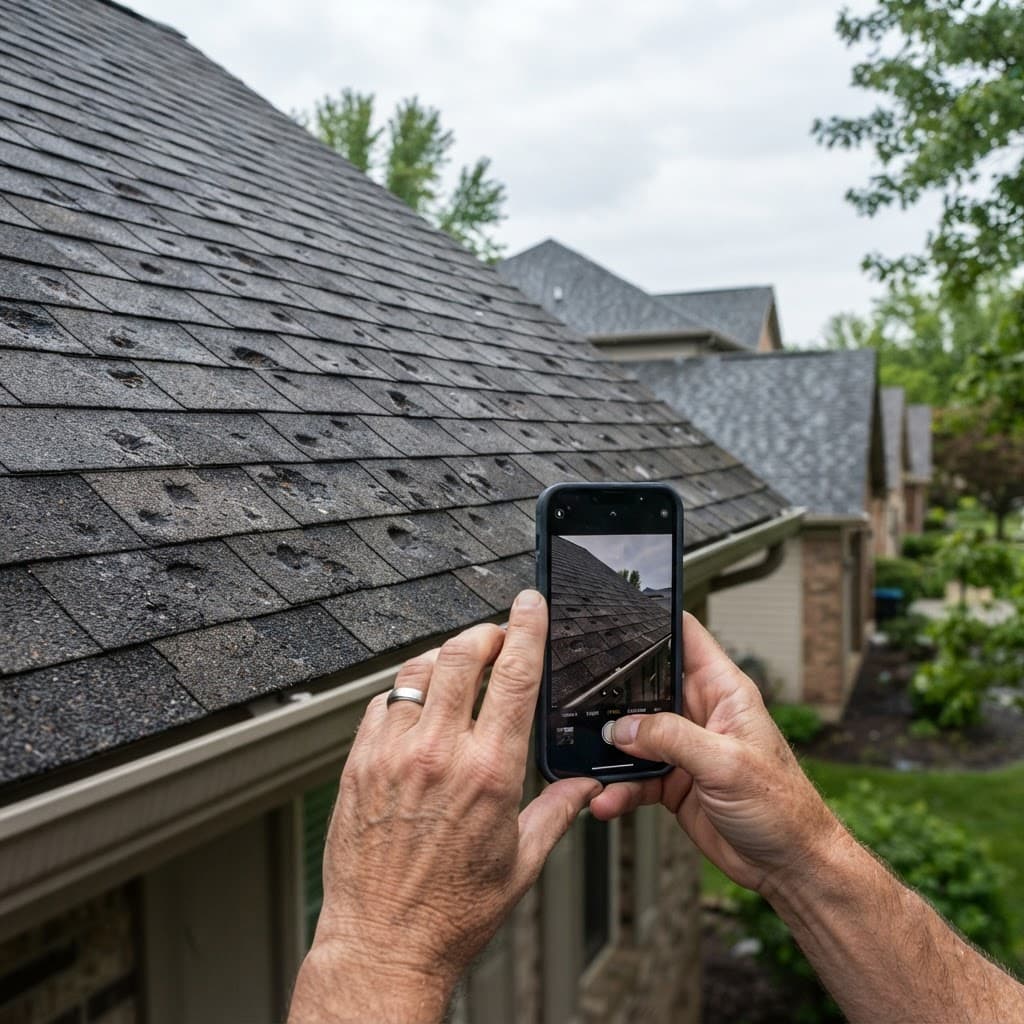
Close-ups of individual shingles (bruises, granule loss, lifted or creased tabs), cracked vinyl siding, torn window screens. Keep a scale reference in frame when you can. Do NOT climb the roof — ground-level close-ups plus a documented professional inspection cover what the claim needs, safely. When we inspect, the close-up layer comes from the ladder and drone shots, date-stamped the same way.
Shot type | What it proves | How many |
|---|---|---|
Wide (all elevations) | Storm exposure + property condition | 4 to 8 |
Mid-range (roofline, gutters, vents) | Damage pattern on accessories | 8 to 15 |
Close-ups (shingles, siding, screens) | The evidence layer | 10 to 20 |
Interior (attic, ceilings, walls) | Active water intrusion | 3 to 6 |
Personal property (furniture, cars, patio) | Claimed items in context | as needed |
Step 4: Interior and Attic
Water stains on ceilings, wet insulation, daylight through the deck boards from inside the attic. Interior shots connect the roof damage to actual loss — that's the causal link the claim depends on. Wet interior materials left past 24 to 48 hours become a mold problem the claim grows to cover (EPA cleanup guidance). Photograph the date stamp visible on whatever shows the leak's timeline (a stain grows in a documented sequence).
Step 5: The Paper Trail
Receipts for tarps, buckets, fans, hotel nights if the home is unlivable, and any emergency service calls — emergency tarping typically runs 200 to 1,000 dollars, and every dollar of documented mitigation belongs in the file. Mitigation spending is typically reimbursable and your policy expects you to stop further damage — see our emergency tarping guide for what that work costs and why the receipt matters. Keep every damaged item until the adjuster has seen or photographed it.
Step 6: The Written Timeline
One page, notebook format: the storm date and source (NWS-verified), when you noticed damage, every call you made, who came out and when, what was spent. For Northeast Ohio's 2026 season, the storms that generated claims were documented events — April 15 (2.00-inch hail, 90 mph microburst near Canton), June 14 (hail, 80 mph winds, four tornadoes region-wide), August 22 (1.75-inch hail), and September 3 (hail in Cleveland), all in NWS Cleveland's event archive. "The storm on June 14" is a claim fact; "some hailstorm a while back" is a denial risk.
The Adjuster Meeting: Hand Over the Package
When the adjuster visits, the file does the talking: the photo set in order — we organize 25 to 50 photos by elevation on a typical four-side home — the timeline page, the receipts. Walk the damage once with them. Point out the mid-range accessory damage that proves the pattern — it's the layer adjusters weight most, because soft-metal dents are hard to fake and easy to verify. Wind and hail claims average 13,511 dollars nationally, and roughly 1 in 35 insured homes files one in a given year (III) — that's the money the documentation fights for. If your contractor's inspection documented things the adjuster's didn't, the supplement process corrects the scope. Our full claims guide covers that process end to end.
What Not To Do
Don't patch before photographing. Photos of repaired areas prove nothing.
Don't throw away damaged items — the tarp, the cracked vent, the stained ceiling tile.
Don't guess the cause on the record. State the storm and date; let the inspection determine hail versus wear versus workmanship. A wrong guess ("hail" on a wear pattern) invites the adjuster's favorite word: pre-existing.
Don't accept a first offer before the scope is compared to your contractor's documented repair estimate.
Why This Process Gets Claims Approved
Insurers don't publish approval statistics by documentation quality — but adjusters will tell you the same thing off the record: the complete, timestamped package is the claim that closes fast, and the thin one is the claim that gets picked apart. This documentation process is exactly how YICN supports claims for homeowners across Northeast Ohio, and it's a big part of why roughly 85 percent of the claims we document move through to approval. The inspection, the photos, the scope, the adjuster meeting — our storm damage first-response guide puts it in order.
Start with a free, documented inspection: call (937) 756-2124 or reach us here.
Frequently Asked Questions
About the Author: Kevin Stone , chairman and founder of YICN Roofing (Your Insurance Claims Network), Northeast Ohio's premier storm damage roofing contractor serving homeowners throughout Bedford Heights and the surrounding 30-mile radius. Operating from the company's headquarters at 5420 Mardale Ave, Bedford Heights, OH 44146, Kevin has transformed YICN Roofing into a top-rated roofing company with an A+ Better Business Bureau score and over 100 satisfied customers who trust his expertise for their most critical roofing needs. Since establishing YICN Roofing, Kevin has built a reputation that extends far beyond traditional roofing services. His comprehensive understanding of the insurance claims process, combined with decades of hands-on roofing expertise, has positioned YICN Roofing as the go-to contractor for Northeast Ohio homeowners facing storm damage, emergency repairs, and comprehensive roof restoration projects. Available 24 hours a day at (937) 756-2124, Kevin ensures that no homeowner in Bedford Heights, Cleveland, Akron, or surrounding communities is left vulnerable to the elements when roofing emergencies strike. Northeast Ohio Roofing Expertise and Regional Understanding Kevin's deep expertise in Northeast Ohio roofing stems from his intimate understanding of the region's unique weather challenges and architectural requirements. The Greater Cleveland area, including Bedford Heights and surrounding communities, faces some of the most demanding weather conditions in the Midwest. Lake-effect snow systems regularly dump heavy loads on residential roofing systems, while spring and summer storms bring devastating wind and hail damage that can compromise even the most well-maintained roofs. Throughout his career, Kevin has personally overseen thousands of roofing projects across Northeast Ohio, from emergency tarping services during severe storms to complete roof replacements for homes damaged by hail, wind, and ice. His experience spans residential neighborhoods in Bedford Heights, where older homes require specialized attention to maintain their architectural integrity, to newer developments in surrounding communities that benefit from modern roofing materials and installation techniques.